
Seatrec Awarded $30.8 Million in Department of War APFIT Funding to Accelerate Persistent Undersea Monitoring Capabilities

Seatrec Awarded $30.8 Million in Department of War APFIT Funding to Accelerate Persistent Undersea Monitoring Capabilities

Selection Underscores the Joint Warfighting Capability Need for Operational Deployment of Seatrec’s Persistent Subsea Autonomous Profiler

San Diego, California — July 21, 2026 — Seatrec, a leader in thermal-powered, long-endurance subsea drones, today announced that it was selected by the Department of War (DoW) to receive a $30.8 Million award under the Accelerate the Procurement and Fielding of Innovative Technologies (APFIT) program.  The award will fast-track the production and scaling of Seatrec’s Persistent Subsea Autonomous Profiler (PSAP), an attritable subsea platform delivering persistent undersea domain awareness capability to U.S. forces.

"This APFIT award is an important step in our mission of bringing the Navy persistent 24/7 undersea information, covering areas that are presently largely unmonitored,” said Dr. Yi Chao, CEO and Founder of Seatrec.  “With this APFIT support, we’re delivering PSAP systems immediately to warfighters to meet their requirements and fill critical gaps in maritime domain awareness.”

The PSAP is based on Seatrec’s commercial product - the infiniTE™ float.  PSAP is the first subsea drone powered by the energy harvested from temperature gradients in the ocean.  Power-demanding sensors, such as passive acoustic hydrophones for soundscape monitoring and active acoustic echosounders for seafloor mapping, can now be integrated on the PSAP platform with essentially unlimited endurance.  PSAP systems are attritable and can be deployed at scale.

After a successful pilot demonstration in collaboration with the Naval Postgraduate School (NPS), the PSAP earned support from the Commander, Naval Meteorology and Oceanography Command (CNMOC).  This APFIT award will allow Seatrec to deliver PSAP systems with the required sensors and payloads to warfighters as early as the last quarter of 2026.

“Accelerating innovative technologies that support our persistent undersea situational awareness—and delivering them into the hands of warfighters quickly—enhances the joint force’s ability to ensure our national security,” explained Dr. Jason McKenna, the Chief Technology Officer at CNMOC.  “The ability to quickly transition groundbreaking technology like Seatrec’s PSAP to scalable production shows the impact of the APFIT program.”

The APFIT program, established in Fiscal Year 2022 by Congress within the Office of the Under Secretary of War for Research & Engineering (OUSW(R&E)), is designed to transition mature, mission-ready technologies that fill joint warfighting capability gaps into production and fielding at scale.

The APFIT award allows Seatrec to immediately begin low-rate initial production (LRIP) of PSAPs in Seatrec’s existing California facility. Additionally, Seatrec plans to expand capacity with a full-rate production (FRP) facility in Mississippi to meet the Department’s future demand.

"PSAP is a good example of what we're trying to build across the Department: get a validated prototype through experimentation fast, then hand it to a program like APFIT that can scale it into the fleet without losing years to the old requirements process," said Dr. An (Mike) Tran, Director of Prototyping, Office of the Deputy Assistant Secretary of War for Prototyping and Experimentation within the Office of the Under Secretary of War for Research and Engineering.”

"This is exactly what our Prototyping and Experimentation mission is built to do,” Dr Tran said. “And exactly the kind of company the Department's Mission Engineering Integration Activity (MEIA) work is built to find: a small, innovative business with a real capability.  We rely on industry like Seatrec to bring us solutions we would not generate ourselves, and we leverage our Tier 1 (Technology Validation) events like Technology Readiness Experimentations (T-REX) to pressure-test them with the Services before we ever ask for production dollars.  PSAP earned its way to APFIT.  That is the model we want more small businesses to follow."

The APFIT 26-2 awardees and program updates are posted on the Department of War’s news releases website.  APFIT program details are available on the Department of War’s APFIT website.


ABOUT SEATREC

Seatrec designs and manufactures subsea drones that generate electricity from ocean temperature gradients.  Our products empower defense and oceanographic researchers to extend mission durations, optimize data collection, and reduce operational costs.

Seatrec’s energy-harvesting core technology was developed at NASA’s Jet Propulsion Laboratory and spun out of the California Institute of Technology in 2016.  Seatrec is headquartered in Vista, California.  Visit us at seatrec.com.


Media Contact
Marta Bulaich
Seatrec, Inc.
marta.bulaich@seatrec.com
+1 (415) 816-1665

WebWire Link


First Hydrophone-Equipped Float Deployed in the Gulf of Mexico

Advancing hurricane forecasts and protecting Rice’s whales

Last week, we deployed our latest infiniTE™ Float off the coast of Florida—the first of its kind in the Gulf of Mexico to carry both a CTD sensor and a hydrophone (an underwater microphone). A CTD sensor measures conductivity (to calculate salinity), temperature, and depth, providing a detailed view of how warm water is distributed below the surface. That subsurface heat can fuel hurricanes to strengthen quickly. Satellites capture only surface conditions, but they cannot detect the deeper layers of warm water linked to rapid intensification. As tropical storms approach the Gulf, the float will profile subsurface layers every six hours, providing data to help improve intensity forecasts. At the same time, the hydrophone will collect acoustic information for soundscape monitoring to support marine conservation, particularly for the critically endangered Rice's whales.


Building on success in Hawai'i and expanding partnerships

This summer, our Persistent Smart Acoustic Profiler (PSAP)—a SEATREC infiniTE™ Float developed in collaboration with the Naval Postgraduate School (NPS)—reached a milestone of 1,000 dives to depths of 700 meters.

Launched off the coast of Kona, Hawai‘i in November 2024, the PSAP carried a CTD sensor and a passive acoustic hydrophone, processed data onboard, and transmitted results in real time. Powered entirely by SEATREC’s patented thermal energy harvesting system, it generated more electricity than it consumed, harvesting over 10 megajoules (2,800 Wh) in just seven months—more than twice the energy of a conventional battery-powered float.

NPS’s interest in this effort was clear. Persistent, real-time ocean intelligence is critical for missions such as undersea warfare and maritime domain awareness, and the PSAP platform demonstrated that it could deliver both oceanographic and acoustic data without relying on external assets. It also provided valuable datasets for METOC program students, linking applied research with Navy readiness.

The success of PSAP in Hawai‘i validated the endurance and self-powering capability of the platform. It also proved that long-term, multi-sensor ocean monitoring is achievable. With that foundation in place, our next step was to expand the mission into the Gulf of Mexico, where hurricane intensification and the habitat of the Rice’s whales present urgent challenges for science, conservation, and coastal resilience


What makes this float different

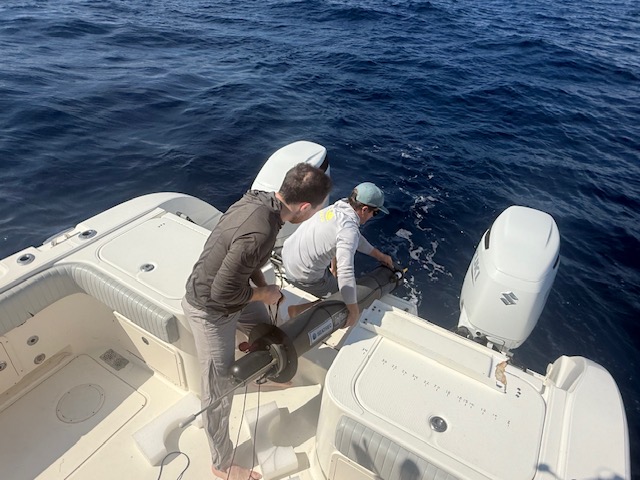
Seatrec Team Members Michael Zedelmair and Josh Laney prepare for launch.

Building on the PSAP's design, this infiniTE™ Float carries a suite of sensors and capabilities tailored to both hurricane forecasting and marine life monitoring:

  • CTD sensor — measures conductivity (salinity), temperature, and depth to profile ocean conditions throughout hurricane season
  • Hydrophone with onboard processing — captures and analyzes underwater soundscapes in near real time
  • Remote reconfiguration — allows the system to focus on detecting Rice’s whale vocalizations for targeted acoustic tracking within their federally designated critical habitat in the Gulf of Mexico.

Diving deep, surfacing more frequently

Real-Time Dive Data: Temperature, Salinity, and Density Profiles 

Every six hours, the float dives to as deep as 800 meters, collects data, and resurfaces to transmit a snapshot of the ocean’s physical state. The data reveal how warm water is layered below the surface—conditions linked to rapid hurricane intensification. Each profile adds new observations of the Gulf’s subsurface and provides inputs that forecasters can use in intensity models.


Why it matters

This mission bridges science, technology, and conservation:

  • For coastal communities: better hurricane forecasts and more lead time to prepare.
  • For researchers: more oceanographic data that deepens understanding of ocean-atmosphere interactions.
  • For marine life: acoustic monitoring that supports conservation of critically endangered species such as Rice’s whales.

SEATREC’s vision is to harvest the ocean’s natural energy gradients to power smarter, longer-lasting ocean drones and power systems. This deployment in the Gulf is another step toward that future


Follow along

We’ll be sharing more from this mission as the float continues its journey. Stay tuned as real-time ocean data shape the way we forecast hurricanes and protect marine life.


Sign up for our newsletter

Get the latest Seatrec news and updates.

Sign up for our newsletter

Get the latest Seatrec news and updates.

Contact Details


Seatrec HQ
1340 Specialty Dr., Suite I
Vista, CA 92081

Seatrec Satellite Office
Gulf & Ship Island Building
2605 13th Street
Gulfport, MS 39501

+1 626 386 5988
www.seatrec.com
info@seatrec.com

Privacy Preference Center