

01We have another Winner!

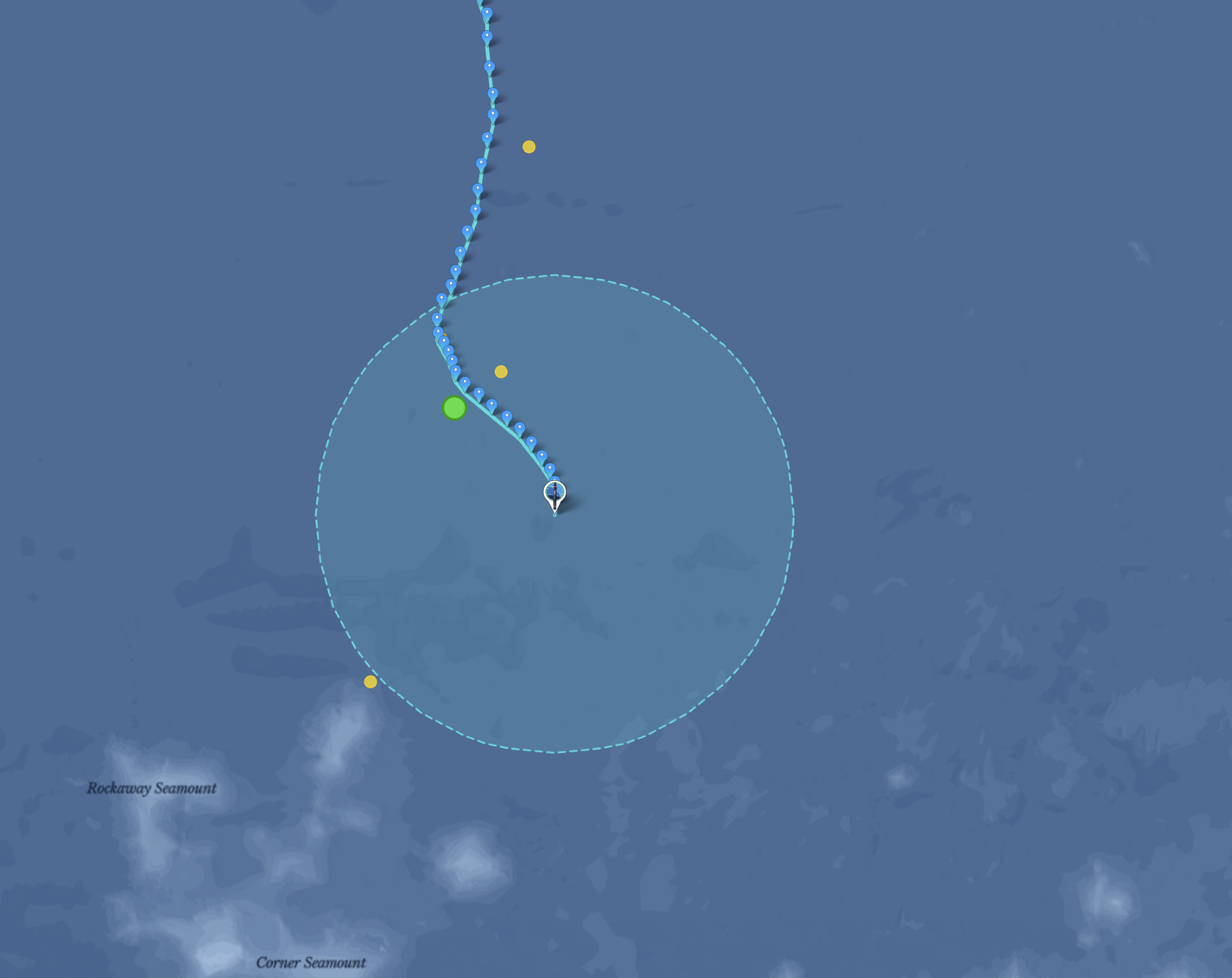
Meet Knut-Frode Dagestad, our second Where’s the Monk winner — a senior researcher at MET Norway (Norwegian Meteorological Institute | Meteorologisk institutt) who landed the closest guess of all: just 61 km from where The Monk actually surfaced on July 20, 2026.
But he didn’t just predict The Monk’s position — he helped build the tool that made it possible. Knut-Frode is a co-developer of OpenDrift, the trajectory-modeling framework our first winner, José Manuel Echevarría Rubio, used to win the contest. The two have never met, or even spoken — Knut-Frode only learned of the connection when José Manuel’s LinkedIn post about the win crossed his feed.
02The Results
This round came down to a tight finish: three predictions landed within 100 km of The Monk’s actual surfacing position. Knut-Frode’s guess placed him closest of all — just 61 km out. Honorable mention goes to Liesvy Valladares Alfonso, a Physical Oceanographer and PhD Candidate at CICIMAR-IPN (Centro Interdisciplinario de Ciencias Marinas, Instituto Politécnico Nacional) in La Paz, Baja California Sur, Mexico, whose prediction also landed within 100 km — the very same institution as our first contest’s winner, José Manuel Echevarría Rubio. The other honorable mention goes to Zach Dubroc, Instructor at the Mississippi Coding Academies.
03The Winning Prediction
“I only discovered this competition after it was two or three days before the deadline, so I did it — I would say, embarrassingly simple approach. If I had more time, I’d do something more along the lines of what José Manuel did, because he did a much more sophisticated job. But I was in a hurry, so I did it almost primitively.”
— Knut-Frode Dagestad
Here’s the forecast he ultimately submitted — run forward from The Monk’s last known position using currents at 700 meters depth, pulled from the Copernicus Marine Service’s Global Ocean Analysis and Forecast product — the Mercator global model.
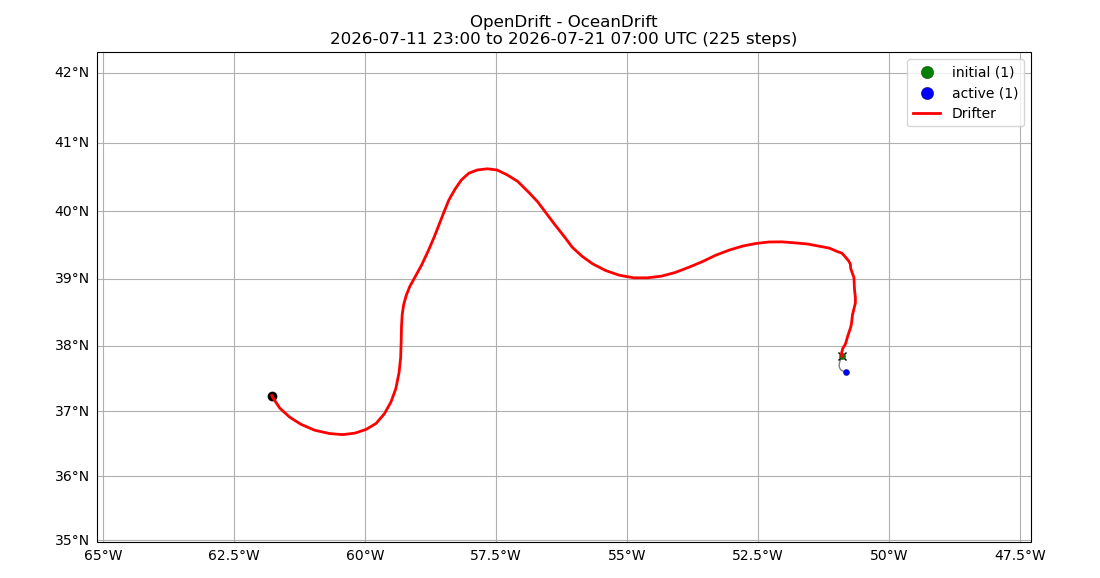
To trust that current field, he tested it against history first. Using the float’s known track from June 1 to July 12, he simulated 24 hours of drift starting from each day’s position, then checked whether the simulated endpoint lined up with where the float actually was the next day.

For comparison, he ran the same test using surface currents instead — checked against the actual track, the surface-current simulations drift visibly off course.

Looked at on their own, without the historical track for reference, those surface-current simulations don’t reveal anything wrong.

But checked the same way against the real track, the 700-meter-depth simulations hug the historical path far more closely — confirming which current field to trust.

“There’s a lot of randomness, a lot of uncertainty in this. It’s like — a dice roll will take it.”
— Knut-Frode Dagestad
This time, the dice landed within 61 km.
04The Interview
What drew you into oceanography in the first place?
“I wanted to study theoretical quantum physics, or something more hardcore physics. But then I found it interesting, though a little far from everyday life — and very narrow. I think it’s nice to do something more related to everyday life, something normal people can relate to.”
“So then meteorology — that was quite interesting. It was actually more mathematical and physical than I expected, because people on the street would say it’s guesswork. They don’t know how much physics is behind meteorology. I liked that it was relevant to society, and still interesting.”
He grew up about an hour inland from Bergen, Norway — near a lake, not the ocean. But I think most people feel attached to the ocean regardless. For me, though, it wasn’t really the ocean itself — it was more the physics, the problem-solving, and a bit of randomness that led me first into meteorology, and then into oceanography, because the two are so connected — you can’t really study one without the other.”
How did OpenDrift come about?
“We already had a service, with some older models running — but we had three different models in three different programming languages. What we realized is there’s so much overlap between oil-spill modeling, search-and-rescue drift modeling, dust modeling, and iceberg modeling that we just made one framework, with separate models for each specific task built on top of it. So we made one generator instead of three separate ones.”
Knut-Frode has worked at MET Norway for about ten or eleven years, building tools for exactly this kind of problem: modeling where things — oil, people and objects in search-and-rescue cases, dust, icebergs — end up carried by ocean currents.
Did you use machine learning for this prediction?
“We do drift modeling with machine-learning corrections at times, but in this case I didn’t use it, because my colleague who works on the machine-learning side was on vacation, and I didn’t want to disturb him. Next time, we’ll add a machine-learning correction to it.”
“I don’t believe in an approach where you use only machine learning. You need a physical grounding as your basis, and you use machine learning as a correction — a post-processing step for the part you can’t otherwise model, the part you can’t fully understand but can fit with machine learning.”
Any advice for people entering the next contest, or using OpenDrift generally?
“I don’t think I’d give advice, because I think it’s good that there’s variability — that people test different approaches. If everyone agreed on the same advice, we’d all end up more uniform, and it might turn out that an approach we didn’t believe in works better. So I wouldn’t give advice — but for my own sake, I believe in a combination of physics as a foundation and a bit of machine learning. Not too much, but a good combination. It’s a fantastic tool — you just have to figure out where to use it and where not to. I think that’s true not just in oceanography, but in society as a whole.”
On the value of the contest format itself:
“I think this competition is not only fun — it’s really useful for everyone involved. It’s a deadline, and you don’t know the answer, so you really need to think and sharpen yourself before submitting. If you’re a researcher just playing with data you already have, you can be focused, but it’s not the same sharpness.”
05What’s Next
There’s more to come — Knut-Frode will be joining us live for “Finding The Monk: How to Predict Where the Ocean Takes a Float,” a walkthrough of the trajectory-prediction techniques behind this win, including the surface-vs-depth validation test and the forecast run above. Bring your questions — he’ll be there to answer them live.
Save the Date
Finding The Monk: How to Predict Where the Ocean Takes a Float
Tuesday, August 18, 2026 · 9:00 AM PDT