
Yi Chao on NDIA’s Emerging Tech Horizons

In a special edition of NDIA’s Emerging Tech Horizons, recorded live at the 2026 Emerging Technologies Conference in Washington, DC, Seatrec founder and CEO Dr. Yi Chao sat down with host Mark Lewis. They discussed how Seatrec’s ocean-powered drones went from an idea born at Caltech and NASA’s Jet Propulsion Laboratory to a technology now headed into the hands of the warfighter.
The problem: batteries. We’ve mapped about 99% of the Moon but only about 25% of the seafloor. Underwater sensors and drones run on batteries, and when those batteries die, the choice is to abandon the device or pay for a ship to recover it. That cost limits how much of the ocean we can observe.
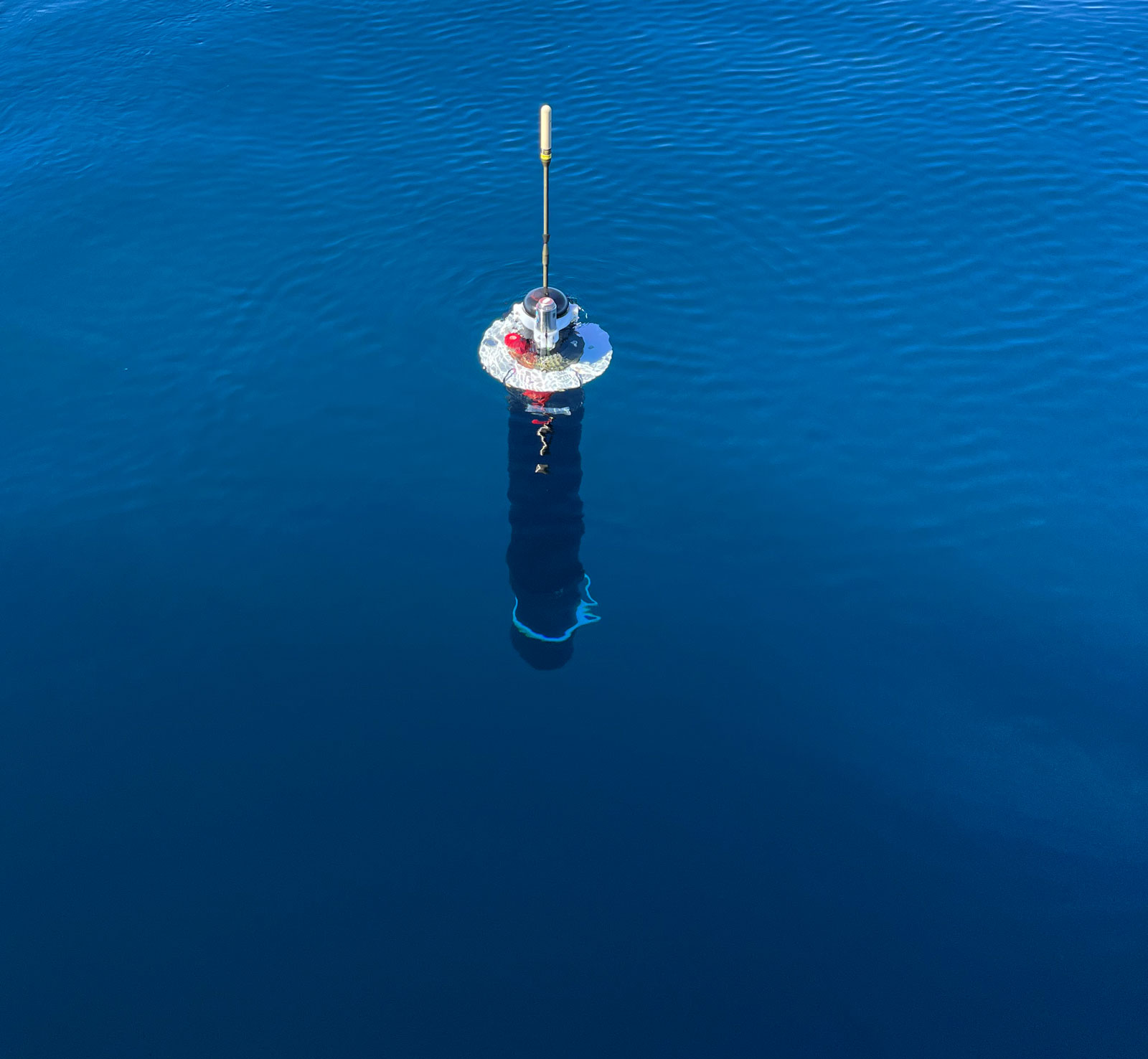
The solution: energy from the ocean itself. Seatrec’s floats use a wax-like phase-change material. When a float rises into warmer water, the material melts and expands about 10%. That pressure spins a generator that recharges the battery. The material can be tuned to the waters where a float operates, so energy is no longer the limit.
The path from research to the fleet:
- Basic research at Caltech/JPL, funded by the Office of Naval Research
- Seatrec spins out in 2016 and matures the technology through SBIR and STTR awards
- A Defense Innovation Unit accelerator puts the team in front of INDOPACOM and the Pacific Fleet
- Prototyping funded by the Office of the Under Secretary of Defense for Research and Engineering, plus fleet exercises
- Today: a new contract to deliver vehicles to the Navy and scale up manufacturing in Mississippi, near our Navy and oceanography customers
Our thanks to NDIA and Mark Lewis for the conversation, and to NDIA for its support of the SBIR program.
Read the full transcript
Show: Emerging Tech Horizons special edition, recorded live at NDIA’s 2026 Emerging Technologies Conference, Washington, DC
Recorded: September 2026
Participants: Mark Lewis, host; Dr. Yi Chao, Founder and CEO, Seatrec
Video: Watch on YouTube (this conversation is the first of two in the episode)
This transcript has been lightly edited for clarity (clean verbatim). Timestamps are approximate and link to that point in the video.
[00:03] Studying the ocean from space
Mark Lewis: Welcome to Emerging Tech Horizons. I’m Mark Lewis, and I’m coming to you from the Emerging Technologies Conference 2026, sponsored by the National Defense Industrial Association. In this segment, I’m joined by Yi Chao, who is going to tell us a remarkable story about a technology that has gone all the way from basic research into the hands of the warfighter. To start off, can you tell us a little bit about yourself? Then we’ll talk about this product you’ve been working on and some of its history.
Yi Chao: Thank you for the opportunity. My name is Yi Chao. I’m the founder and CEO of Seatrec. Seatrec is a spinout of Caltech. We were funded by the Navy’s Office of Naval Research to develop this technology to harvest energy from the ocean. I’m an oceanographer. I have a PhD in oceanography and have studied the ocean for 20 years.
Mark Lewis: And you were working at the Jet Propulsion Laboratory.
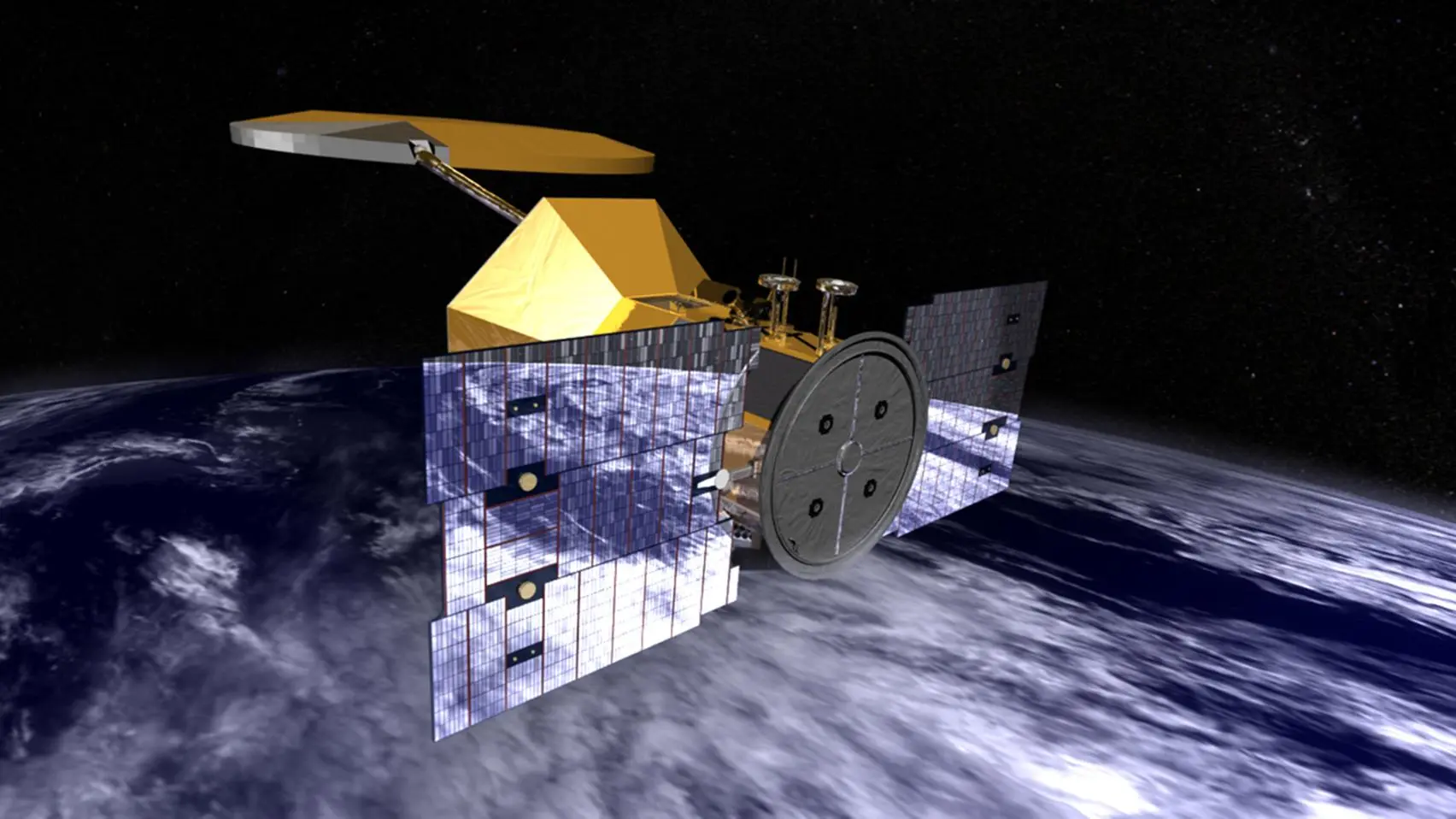
Yi Chao: I worked for Caltech/NASA’s Jet Propulsion Laboratory, studying the ocean from space. The challenge is that satellites only see the surface. We don’t really know much about what’s below the surface. From the sea surface to the seabed, it’s all unknown.
Mark Lewis: I’ve heard it said that we know more about the surface of the Moon than we do about the bottom of the ocean.
Yi Chao: Very true.
Mark Lewis: Yes.
Yi Chao: Because we have mapped 99% of the Moon and 99% of Mars, but we’ve only mapped 25% of our seabed. Imagine your Google Maps is missing 75% of the roads. Would you be able to drive with that map?
Mark Lewis: That would be a challenge. Understood.
[01:37] The battery problem
Yi Chao: During my NASA career, I ran into these challenges for the Navy and also for ocean research and exploration in general. Underwater sensors and drones are powered by batteries, and these batteries have a limited lifetime. When the battery runs out, you have two options. You let it go, and it becomes trash in the ocean, or you hire a boat to recover them, swap the batteries, and deploy them again. As these drones and sensors drift farther from shore, the farther from the harbor, the more expensive it becomes. At some point, it’s almost more expensive to hire a boat to recover one than to just deploy a new one. That really limits how many sensors we put in the ocean, and that’s probably why we know so little about the ocean. So energy is the biggest challenge, and it’s a challenge the Navy faces as well.
[02:35] How it works
Yi Chao: So I did a study in the library at that time, and I discovered this concept proposed back in 1989 that used a wax-like phase-change material to harvest energy from temperature differences.
Mark Lewis: So it’s a phase-changing material.
Yi Chao: It’s a phase-change material, PCM. It’s like a wax. That particular concept used the wax to melt from solid to liquid, and used the volume expansion to drive the robot moving up and down. I said, that’s a really good idea, but if you don’t generate electricity, you cannot store that expansion. So I worked with two smart engineers at JPL, and the three of us invented a new concept: how about using wax PCM to generate electricity?
When the robot comes to the surface, it moves from cold water to warm water, so the solid material wax melts once it crosses the phase-change temperature. The melted liquid has 10% more volume than the solid, and that 10% expansion generates a huge hydraulic pressure that spins a motor to generate electricity. Once you generate electricity, you can store it in a rechargeable battery. Once the battery is fully charged, you can do scientific missions: data collection, computing, and real-time satellite data transmission.
Mark Lewis: Very clever. Obviously, if it’s undergoing a phase change, it’s going to be temperature sensitive. So do you tune it for the part of the world you’re operating in?
Yi Chao: There’s a family of materials we can pick from, depending on the area of operation. For our Mediterranean customer, for example, the bottom temperature is 14°C. If we pick an 18°C phase-change temperature, that material will generate electricity in the Mediterranean. But a Hawaii customer wants 10°C. So it depends on the area where the drones and sensors are deployed. We just pick the right material with the right phase-change temperature.
Mark Lewis: But it is flexible. Understood.
[04:31] From research to a company: ONR, SBIR and STTR
Mark Lewis: Great. So now tell me the journey of how you got from what sounds like a basic research concept, through all the various levels in the Department, to get it into operation. What are the steps you followed?
Yi Chao: We developed the prototype under the ONR contract.
Mark Lewis: That’s the Office of Naval Research, which sponsors basic research work for the U.S. Navy.
Yi Chao: That’s correct. They contracted Caltech to develop this prototype, and we had two patents granted to Caltech. We had a prototype deployed in the ocean for 18 months, completing 1,000 profiles from the surface to 1,000 meters. So for the first time, we had an underwater drone completely powered by the ocean.
Mark Lewis: When was the ONR part of this?
Yi Chao: That was more than 10 years ago, about 12 years ago. Then about 10 years ago, Seatrec spun off from Caltech. I decided to quit my job to start Seatrec. I had two patents granted. I had a prototype. How hard could it be to get it commercialized?
So basically, I started Seatrec 10 years ago, in 2016. We just celebrated our 10-year anniversary. After we spun out, we continued to get SBIR (Small Business Innovation Research) money to help us through the commercialization process. We also got an STTR.
Mark Lewis: I want to come back to the SBIR process. The SBIR program is an amazingly powerful program. And you start with Phase I.
Yi Chao: We started with Phase I.
Mark Lewis: Which is relatively modest funding.
Yi Chao: Phase I is a small amount of money for paper studies and laboratory studies. Then we got a Phase II SBIR, working with industry and academic institutions to continue maturing the technology. We had Phase II, and then even a Phase II option. And eventually we got an STTR to work with the Woods Hole Oceanographic Institution.
Mark Lewis: An STTR is very much like an SBIR, but you have to involve…
Yi Chao: More participation from a research organization. It allows us to work with researchers and professors.
Mark Lewis: Again, an amazing program that helps bring ideas out of the research laboratory at, say, a university, into industry, and then ultimately into a product.
Yi Chao: It’s critical for a small startup without a lot of private equity capital. Many early startups fail because they probably raise too much capital before the product matures, and the timescale for equity investment to see a return on investment is very short, so you need to go really fast. A lot of maritime and ocean tech takes longer.
Mark Lewis: Right.
Yi Chao: The ocean is very challenging. The experimental cycle is very long. You have to deploy and test, and then recover, and then analyze.
Mark Lewis: Right.
Yi Chao: So it’s much longer than software, much longer than consumer products. This is deep tech, maritime tech, so it just takes longer. Having SBIR and STTR to reduce that risk before we bring investors in is critical. We have raised small amounts of private capital, but SBIR and STTR are the main vehicles.
Mark Lewis: I’m going to put in a plug here, because we’re at the National Defense Industrial Association conference. NDIA was actually instrumental in getting the SBIR program reauthorized.
Yi Chao: Thank you.
Mark Lewis: So a shout-out to the SBIR. When I worked for NDIA, my colleague Kea Matory led that effort and explained to Congress the importance of the program. Efforts just like yours really shine a light on what the SBIR portfolio can do.
Yi Chao: Thank you for that support! You enabled us to be successful.
Mark Lewis: NDIA, yes.
[08:30] Meeting the warfighter
Mark Lewis: So you go through the SBIR phases. What came next?
Yi Chao: Then we launched our commercial product about four years ago. That was in the middle of COVID, so we did limited sales to the research market, mainly universities and NGOs. About three years ago, I participated in the NSIN Accelerator (National Security Innovation Network).
Mark Lewis: From the Defense Innovation Unit (DIU).
Yi Chao: From DIU, NSIN Propel Hawaii. It’s essentially an incubator. They brought 12 startup companies like ours and three maritime companies into a six-month program that gave us access, primarily, to INDOPACOM and the Pacific Fleet. And the highlight of the program was attending the POST Conference for free.
Mark Lewis: Which is sponsored by…
Yi Chao: NDIA.
Mark Lewis: You’re all seeing a theme here.
Yi Chao: Basically, 12 companies crammed into two booths. Everybody had a little corner to show off their technology. It was really eye-opening to talk to the customers, the warfighters walking by. The POST conference has 2,000 people attending, and half of them are in uniform, coming from different units across the Indo-Pacific and from the Pentagon as well. So for the first time, I was able to learn about the needs, the gaps, and the requirements. That’s really eye-opening for a startup like ours, to say, “OK, I can fill this gap. I can meet these requirements.” The second year, I was able to rent a booth. I saw the value, so the second year I came back to NDIA.
Mark Lewis: Excellent.
Yi Chao: I reserved a small booth for ourselves and did a display. That’s where I met Under Secretary Heidi Shyu. This was three years ago. She asked all the right questions, and she introduced me to her office and Alex Lovett’s office. For the first time, I had a meeting in the Pentagon with Dr. Tran to understand the R&E programs. Then we got funding from the Prototyping and Experimentation Team in R&E for a rapid prototyping project. They bought an initial fleet of three to five units, and we started taking them to exercises. We were in Black Widow with the Pacific Fleet two years ago; we were in T-REX; and we were in the U.S. Virgin Islands, working with Dr. Alexander’s assessment team. And we’re going to do more experiments with Dr. McAllister’s experimentation team. So we are maturing the system, trying to understand where it works well and where we need improvement.
Mark Lewis: I love that story, because first, it involves our basic research investments, which are absolutely critical to advancing knowledge. They flesh out the idea, and then it gets handed off through the SBIR and STTR programs. Then it goes to the Defense Innovation Unit, which is an amazing organization that, as its name implies, is trying to get innovative ideas into the hands of the warfighter. Then you go to POST and meet with the J8, the folks who do the technology development and requirements for INDOPACOM. And by the way, my feeling has always been that INDOPACOM leads in understanding the value of innovative technology, because they have so many challenges in that particular region.
Yi Chao: Yes. For example, I met Bob Stevenson at the POST conference. He was walking around. He gave a keynote. He’s the director of the J8 and requirements, and he saw the value of this technology for their requirements to be met.
Mark Lewis: Yes. And then the Under Secretary of Defense for Research and Engineering steps in with prototyping, and we get to a capability. Phenomenal story.
[12:25] Scaling up
Mark Lewis: So where are we today? Tell us about what you’re doing today.
Yi Chao: Two months ago, we signed a contract for APFIT, so now we are ready to scale up. In addition to the exercises and the ongoing improvements we’re doing, we are ready to transition. The APFIT award we signed two months ago allows us not only to deliver this vehicle to the Navy this calendar year, but also to immediately deliver to different COCOMs, to the Navy, to the Naval Oceanographic Office, and to the Naval Meteorology and Oceanography Command (CNMOC), so they get access to the tools, the sensors, and the data immediately. So we have three years to also scale up our manufacturing.
We identified Mississippi as the site to manufacture our devices.
Mark Lewis: Why Mississippi?
Yi Chao: Because the Naval Oceanographic Office, the Naval Research Laboratory (NRL), and the Commander, Naval Meteorology and Oceanography Command are all at Stennis Space Center. So it all makes sense. Our direct customers are in Mississippi, with thousands of people working at Stennis Space Center. We want to be closer to our customers, so they can come to us to ask questions, we can do training, and we can go to them for meetings and participate in person. A lot of that communication and dialogue will help us understand their needs better.
So we are ready to scale. We are based in San Diego, and we’ll continue to keep San Diego as our commercial research facility and headquarters, where we’ll develop the next generation. And we’re going to do a lot of the Navy manufacturing in Mississippi.
[14:18] Energy and cost
Mark Lewis: Obviously, having something that can run, and I assume it can run almost forever, right?
Yi Chao: In theory, energy is no longer the limitation. The ocean is a very rough environment.
Mark Lewis: There’s a lot of energy in the ocean.
Yi Chao: There’s a lot of energy. So basically, we take energy out as the limitation.
Mark Lewis: So instead of a couple of hours, maybe a couple of days, we’re now into lifespan. How does cost factor into that?
Yi Chao: When I wanted to develop the commercial product, cost was a challenge, because the first prototype cost $3 million.
Mark Lewis: Right. But the first unit is always the first unit.
Yi Chao: Yes. Then we built our first commercial prototype for about $300,000, so we got an order of magnitude. But that’s still pretty expensive. Even the Navy doesn’t want to lose them. So I decided to set a target for my engineering team: let’s price this at $50,000. $50,000 is one day of ship time. If you decide to collect data by sending an instrument down, a day on a commercial vessel is $50,000, and for the Navy it may be $100,000. So we set $50,000 as the base price, and once you populate the sensors, maybe $100,000 on average. But that’s basically one day of ship time, and you’re going to collect data for three years. Now you can deploy a fleet of these, get spatial coverage of any area of responsibility (AOR), and collect data 24/7 with persistent monitoring.
Mark Lewis: Outstanding. Great. Well, thank you so much for sharing this story with us.
Yi Chao: Thank you for the opportunity.
Mark Lewis: Remarkable story. Congratulations on such a successful effort, and enjoy the rest of the conference.
Yi Chao: Thank you. It’s a great conference here. I’ve met a lot of people. Thank you for the opportunity.



From “How Far from Reality?” to Real-Time Ocean Observation
The North American Gulf Stream as illustrated with the ECCO model.
Credit: Greg Shirah / NASA’s Scientific Visualization Studio
From “How Far from Reality?” to Real-Time Ocean Observation
How Seatrec CEO Yi Chao’s early Gulf Stream research comes full circle in an infiniTE™ Float mission now more than 500 profiles in, from the Gulf of Mexico to the western North Atlantic
Three decades ago, long before Seatrec existed, our CEO and founder, Yi Chao, was working on one of the hardest problems in physical oceanography: how to model the Gulf Stream realistically as it separates from the U.S. coast near Cape Hatteras. Today, a Seatrec infiniTE™ float is tracing that broader Atlantic system in the real ocean, more than 500 profiles into a mission spanning the Gulf of Mexico, the Florida Straits, and the western North Atlantic.

That connection is more than a coincidence. It is the throughline of Yi’s career. During his Ph.D. at Princeton, Yi studied El Niño. After graduate school, he turned to the Gulf Stream because one question kept bothering oceanographers: why couldn’t models reproduce its separation correctly at Cape Hatteras? For years, that gap was more than a technical frustration. It suggested that even advanced ocean models were still missing something essential about North Atlantic circulation.
In 1996, while at NASA’s Jet Propulsion Laboratory, Yi co-authored “Modeling the Gulf Stream System: How Far from Reality?” The paper marked an important advance in showing that the Gulf Stream could be modeled much more realistically than before. It was one of Yi’s earliest papers at JPL and helped establish a question that would shape much of his career.
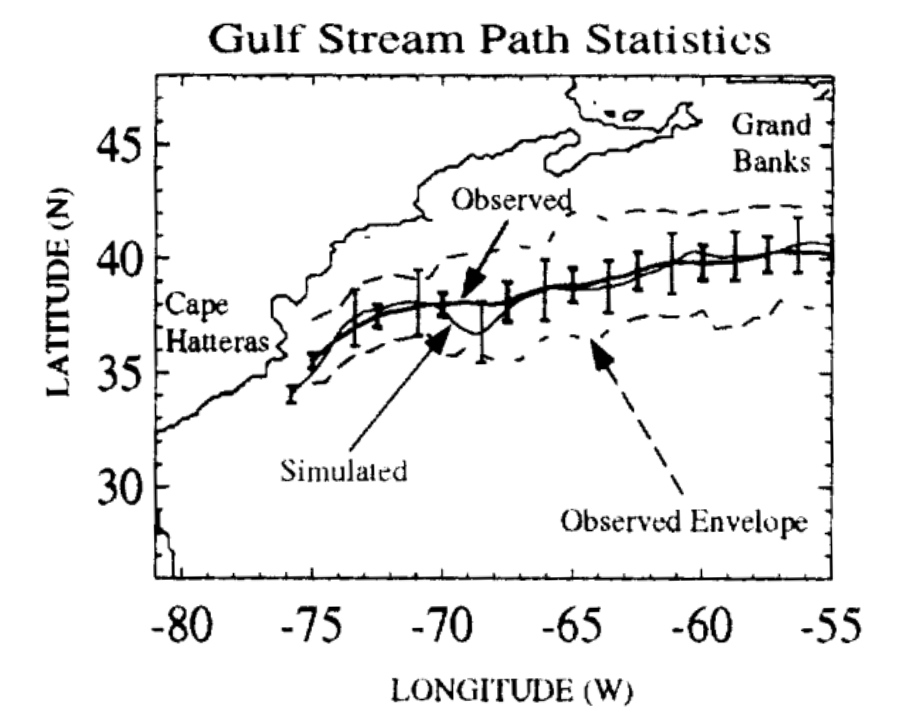
The title of that paper still resonates with us: How far from reality? In many ways, that question sits at the heart of Seatrec. Yi went on to spend roughly 20 years at NASA Jet Propulsion Laboratory working in ocean modeling and satellite oceanography before founding Seatrec in 2016. Our core technology originated at NASA JPL / Caltech, and our mission is to make the ocean more continuously observable by solving one of subsea science’s most stubborn constraints: power.
For decades, oceanographers have had to make difficult tradeoffs. Traditional profiling floats are constrained by primary batteries, which limit mission duration, sampling frequency, and payload flexibility. Satellites transformed our view of the surface ocean, but the subsurface ocean, the heat structure, salinity gradients, mixing, and soundscape, remains much harder to observe persistently. That is the gap Seatrec was built to close.
Seatrec’s answer has been to rethink power from the ocean up. Our infiniTE™ platform harvests electricity from naturally occurring temperature differences between warm surface water and colder depths. As the float cycles through the water column, phase-change materials drive a hydraulic system and generator, producing power for repeated profiling and expanded sensing. The result is a long-endurance platform designed to collect more data, more often, with less dependence on battery replacement and ship support.
This 500-profile mission shows what that looks like in practice. The mission began in the northeastern Gulf of Mexico, south of Destin, Florida. In its first 49 days, the float completed 160 profiles, diving to depths of up to 800 meters while surfacing to transmit real-time data. Equipped with a CTD and passive acoustic hydrophone, it began building a continuous picture of subsurface temperature, salinity, and underwater sound in a region where seeing below the surface matters for both hurricane forecasting and soundscape monitoring.
After 315 profiles, the float entered the Florida Straits, where the mission shifted from broad Gulf drifting to boundary-current sampling. This narrow, deep, high-energy corridor between the Florida Keys and Cuba funnels flow toward the Atlantic and sharpens vertical and horizontal gradients. In this phase, the float was completing about four profiles per day, creating a much denser record of changing subsurface conditions through one of the most dynamic passages in the western Atlantic.
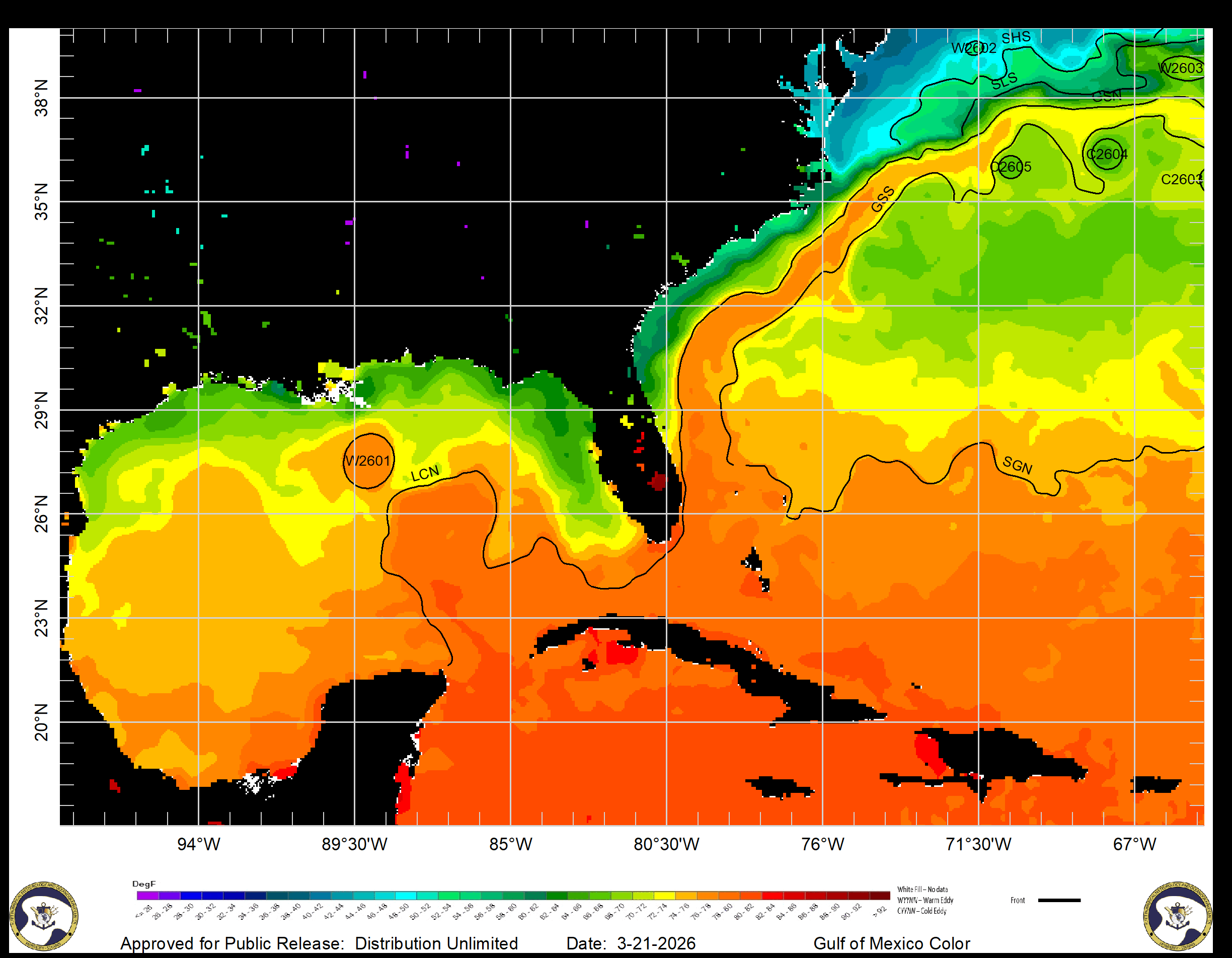
By 480 profiles, the mission had advanced from the Gulf of Mexico through the Florida Straits, up the U.S. East Coast, setting up the next chapter as the float entered the Gulf Stream separation region off Cape Hatteras, the same broader system that defined an early chapter of Yi’s scientific career. What once lived in model grids is now being sampled profile by profile by an autonomous float powered by the ocean’s own thermal gradients.
That is why this milestone feels bigger than a number. Yes, 500 profiles is an operational achievement. But it is also a reminder that the best ocean technology does more than last longer. It changes what is scientifically possible. Seatrec’s milestone is not that this is the first float to sample the Gulf Stream. It is that a thermally powered float is delivering persistent, high-frequency profiling across multiple connected ocean regimes, without the same battery limits that have historically constrained mission duration and sensor use.
Persistent subsurface measurements help reveal the hidden heat structure that can fuel hurricane rapid intensification. They support better understanding of ocean heat transport and water-column structure across connected current systems. And when acoustic sensing is added to the same long-endurance platform, they can also contribute to persistent soundscape monitoring.
For Seatrec, this is a field report. For Yi, it is a full-circle moment. Three decades after asking how far ocean models were from reality, he now leads a company building tools that can stay in that reality longer, profiling through it, transmitting from it, and helping make the ocean more continuously observable. Few scientific careers draw such a direct line from question to platform. This one does.
And the float is still going.
Live tracking: seatrec-floats.com
Data access and collaboration: info@seatrec.com

Seatrec’s infiniTE™ Profiling Float Captures First-of-Its-Kind Fine-Scale Ocean Vertical Structure
Seatrec’s infiniTE™ Profiling Float Captures First-of-Its-Kind Fine-Scale Ocean Vertical Structure, Powered by Temperature Gradients
A serendipitous meeting between ocean engineers and scientists sparked a new float mission to change how the ocean is measured
VISTA, Calif.— Feb. 23, 2026 — Seatrec, a leader in thermal-powered, long-endurance subsea drones, today announced the successful launch of a collaborative scientific mission to develop new autonomous profiling float capabilities that are powered by the ocean’s temperature differences and collect critical data on ocean health and carbon cycling.
This mission originated from a booth conversation at the American Geophysical Union (AGU)-sponsored Ocean Sciences Meeting 2024 (OSM24), held in New Orleans in February 2024. Seatrec CEO and Founder, Yi Chao, Ph.D., met with Mark Altabet, Ph.D, Professor and Chair of the School for Marine Science & Technology at the University of Massachusetts Dartmouth, and Eric A. D’Asaro, Ph.D., Senior Principal Oceanographer of the Applied Physics Laboratory and School of Oceanography at the University of Washington. At the time, Seatrec had recently launched its commercial infiniTE™ float. During discussions, Altabet and D’Asaro explored how the infiniTE float could fundamentally alter sampling strategies for studying turbulence, internal waves, and ocean mixing. That discussion marked the beginning of a co-development effort.
“Data below the ocean surface is significantly lacking because traditional profiling floats are all powered by primary batteries that limit float life and data collection capability,” explained Chao. “The infiniTE float harvests energy from temperature gradients in the ocean, and can therefore collect more frequent measurements and carry new sensors.”
The collaboration resulted in the successful development and deployment of an infiniTE float with two sensors to measure oxygen and total dissolved gas pressure (TDGP), key indicators of ecosystem health, environmental stress, and carbon cycling. The accurate measurement of TDGP requires the float to park at multiple depths and remain at each depth long enough for the sensor to collect reliable measurements.
“This type of mission has never been done before with the existing float products,” said D’Asaro. “The infiniTE float changes the way we think about power in a profiling float. In a battery-powered float, the total energy is fixed, so you try to minimize power usage by minimizing the number of profiles. Since the infiniTE float recharges its battery with the energy harvested from the ocean, there is no power penalty for more profiles.”
“Looking into the future,” said Altabet, “the infiniTE float can be used to profile more rapidly to resolve the diurnal variation of oxygen and its impact on productivity. This could only be done with the infiniTE float in a sustained way.”
This mission builds on Seatrec’s broader efforts to advance long-duration autonomous ocean systems, including a Cooperative Research and Development Agreement (CRADA) with the Naval Postgraduate School focused on enabling persistent, real-time oceanographic and acoustic measurements in open-ocean environments.
Related to this work, Chao will present at this week’s AGU Ocean Sciences Meeting in Glasgow, Scotland, on harvesting energy from ocean temperature gradients to power underwater robots and sensors for persistent monitoring.
About Seatrec
Seatrec designs and manufactures subsea drones that generate electricity from ocean temperature gradients. Our products empower defense and oceanographic researchers to extend mission durations, optimize data collection, and reduce operational costs. By enabling the integration of advanced sensors previously limited in endurance and functionality, such as hydrophones, we open new possibilities for ocean science.
Seatrec’s energy-harvesting core technology was developed at NASA’s Jet Propulsion Laboratory and spun out of the California Institute of Technology in 2016. Seatrec is headquartered in Vista, California. Visit us at seatrec.com.
About the School for Marine Science & Technology, University of Massachusetts Dartmouth
The School for Marine Science & Technology at the University of Massachusetts Dartmouth (SMAST) is a nationally and internationally recognized institution for education and research in marine science and ocean technology. SMAST is a collaborative community of dedicated students and expert faculty working together to address critical challenges in marine science while fostering a supportive and collegial environment. SMAST students and faculty help address urgent issues facing the world’s oceans, including climate change and ocean impacts, food security via sustainable fisheries, sustainable energy development and associated impacts, and coastal ecosystem resilience.
About the Applied Physics Laboratory, University of Washington
The University of Washington Applied Physics Laboratory (APL-UW) was founded by the U.S. Navy in 1943 to conduct acoustic and oceanographic studies on how deep ocean variability affects Navy systems. Today, APL-UW scientists and engineers lead research and applied technologies in acoustic and remote sensing, ocean physics and engineering, medical and industrial ultrasound, polar science and logistics, environmental and information systems, and electronic and photonic systems.
Media Contact
Marta Bulaich
Seatrec, Inc.
marta.bulaich@seatrec.com
+1 (415) 816-1665